Welcome! I am Dorcas Miao, a multilingual and multicultural researcher. Recently, I had the pleasure of guest-teaching a graduate methodologies class for an incredible cohort with diverse backgrounds and teaching experience.
If you are diving into qualitative research, learning how to look beyond the surface and capture thick descriptions is one of the most vital skills you can develop. In this session, we moved past the theory of our pre-class readings, Merriam and Tisdell’s (2016) chapter on being a careful observer and Emerson, Fretz, and Shaw’s (2011) foundational guides on fieldnotes, to get our hands dirty with actual practice.
What We Covered in the Session
Warm-Up & Everyday Observation: We kicked off by unpacking what it truly means to be "observant" in our everyday lives, sharing insights from our personal and professional backgrounds.
The Lecture: I broke down the core pillars of fieldnotes, moving from passive watching to active, disciplined noticing. (You can watch the full recorded lecture below!)
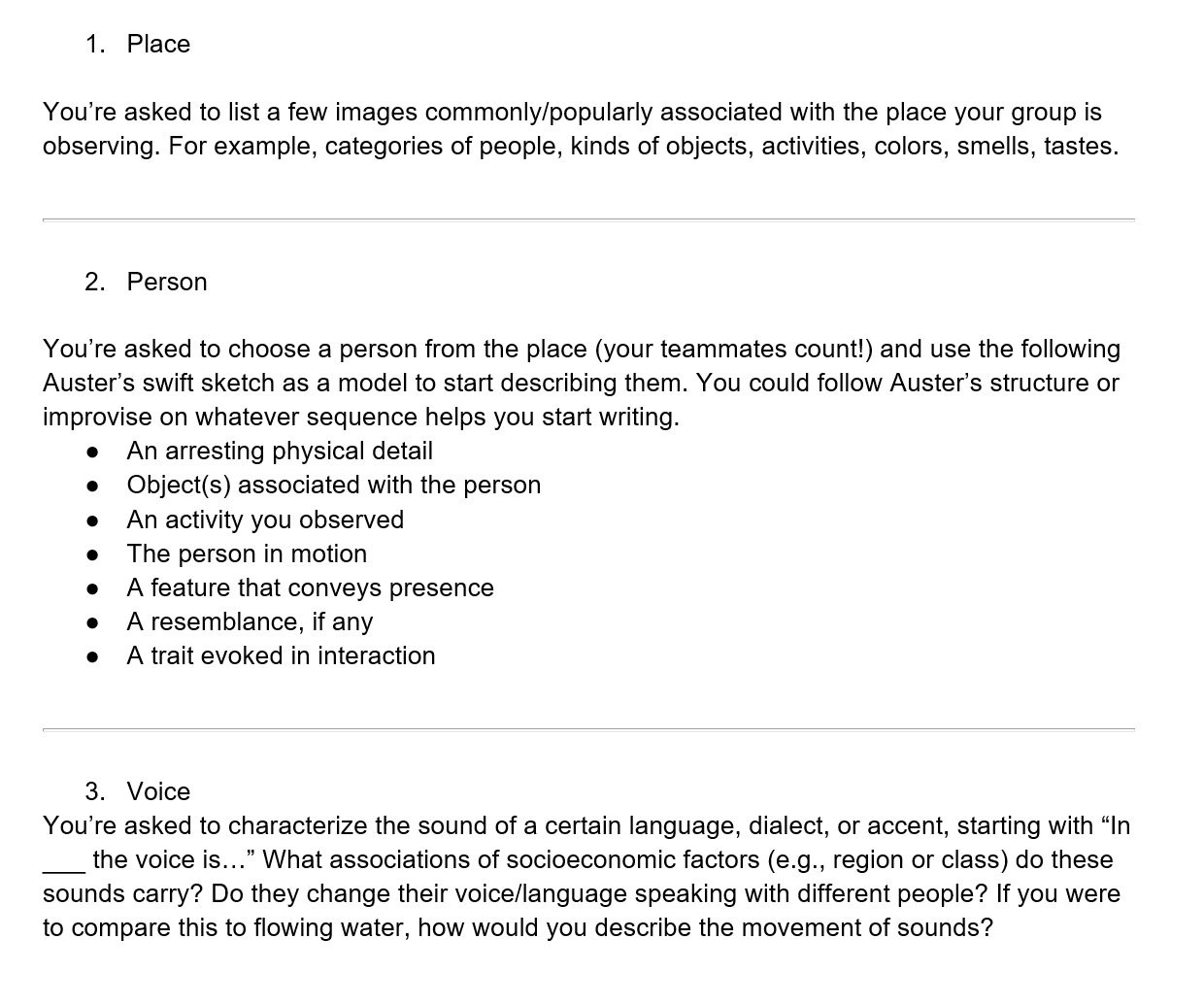
The Three Dimensions of Thick Description: During our hands-on activity, groups deployed specific prompts to isolate and capture the fundamental dimensions of field observation:
Place: Cataloging the physical environment, objects, and atmospheric details.
People: Using structured sketches (inspired by Paul Auster's stylistic framework) to observe physical traits, movement, and presence.
Voice: Characterizing language, accents, and the dynamic movement of sound.
Dissertation Insights & Q&A: We wrapped up by exploring real-world applications from my own dissertation research—including semester-long site observations, navigating IRB boundaries, and deciding what counts as a public space.
Watch the Recorded Lecture
Grab your notebook, settle in, and check out the full recorded presentation below to bring your field observation skills to the next level.
Join researcher Dorcas Miao in this graduate-level workshop lecture on qualitative field methods, where she explores the core principles of fieldwork and translating everyday noticing into rigorous fieldnotes.
Observation Practice Activity
What aspect of field observation—place, people, or voice—do you find the most challenging to capture when you first enter a new research site? Check out the following activity prompt that is adapted from Narayan, 2012, Alive in The Writing: Crafting Ethnography In the Company of Chekhov
Have follow-up questions?
